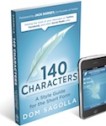
Foreword by @Jack Dorsey

App, Book, Excerpts, History, Twitter-Tips

What you’re holding in your hands is a set of guidelines. A collection of protocols which describe an approach to another protocol, something we call Twitter.

The amazing thing about this particular protocol is that it’s being defined daily. By you. Twitter was inspired by the concepts of immediacy, transparency, and approachability, and created by the guiding principles of simplicity, constraint, and craftsmanship. We started small. We built something out of love and a desire to see it flourish throughout the world. We defined a mere 1 percent of what Twitter is today. The remaining 99 percent has been, and will continue to be, created by the millions of people who make this medium their own, tweet by tweet.

I leave you now in the capable hands of a documentarian, storyteller, and practitioner of a new protocol of communication. Listen, learn, and most importantly, define it for yourself.

-Jack Dorsey Creator, Co-founder, and Chairman of Twitter, Inc.
San Francisco

Foreword to the book 140 Characters: A style guide for the short form (2009, Wiley). Available wherever books are sold, and on iTunes App Store.

  • Share/Bookmark
View Comments

Tweets per Capita

Announcements, Speaking

The Worldwide Congress on Information Technology takes place this week in Amsterdam, Netherlands. As part of my participation, I was asked to deliver a keynote speech on Inclusion. The following research is not comprehensive, but is meant to explore  a new metric for technological and cultural progress.

I took a sample 24 hours of public Twitter traffic on May 16, 2009 (a Saturday) and May 16, 2010 (a Sunday). Twitter data is from Peoplebrowsr, population data from Wolfram Alpha. The resulting Tweets per Capita is an interesting economic indicator.

BEST 2010 Tweets per Capita

  1. Singapore
  2. Netherlands
  3. Australia
  4. New Zealand
  5. USA
  6. Canada
  7. Ireland
  8. Puerto Rico
  9. Brazil
  10. UK

WORST 2010 Tweets per Capita

  1. TIE: Democratic Republic of the Congo & Ethiopia
  2. Kosovo
  3. Sudan
  4. Bangladesh
  5. Uzbekistan
  6. Somalia
  7. Nepal
  8. Pakistan
  9. Nigeria
  10. BVI
  11. Haiti

BEST Tweet Growth

  1. Uzbekistan
  2. Indonesia
  3. Venezuela
  4. Turkey
  5. Thailand
  6. Japan
  7. Nigeria
  8. Brazil
  9. Egypt
  10. Saudi Arabia

WORST Tweet Growth

  1. Iran (decline)
  2. Ethiopia (decline)
  3. British Virgin
  4. US Virgin
  5. USA
  6. Canada
  7. Portugal
  8. Israel
  9. Australia
  10. Aruba

BEST 2010 Tweet Output

  1. USA
  2. Brazil
  3. Indonesia
  4. Japan
  5. UK
  6. Canada
  7. Australia
  8. Netherlands
  9. India
  10. Germany

WORST 2010 Tweet Output

  1. British Virgin
  2. Gibraltar
  3. Kosovo
  4. Democratic Republic of the Congo
  5. US Virgin
  6. Ethiopia
  7. Somalia
  8. Uzbekistan
  9. Sudan
  10. NL Antilles

There were a few surprises here worth further study, some of which I examine in my presentation above: Iran, Haiti, Chile, Venezuela, and the Netherlands.

If anyone is interested in combing through the raw data, please contact me. We also seek sponsors to continue this research and develop a regular report on the topic.

  • Share/Bookmark
View Comments

Economy of Words

In The News, Prediction, Speaking

[Published in Het Financieele Dagblad, the Dutch financial times, on the opening day of WCIT 2010 in Amsterdam.]

A shadow economy controls all of the systems of monetary influence in the world. This system derives value from sharing wealth, in the form of information. It is the economy of words, metered by our attention.

This economic system has the largest and most complex trading floor ever designed by mankind: the public commons. It regenerates in direct proportion to the number of people connected to it, which has no apparent limit.

We are limited by our ability to transform this wealth. Which is to say, the human mind has cognitive bounds, and can only process so much information at once. That is why the average number of words in a sentence is around 16, and the average number of overall characters is around 160. A German man once did that math, and wrote 160 characters into his global standard for mobile text messaging (GSM).

Twitter has a limit of 140 characters, in order to include the identity of the sender in each text message. This constraint has created a marketplace of ideas that may only be expressed in a short format of words, symbols, and hypertext links.

Currency in this system may or may not be persistent; what is written now is not guaranteed to grow in relevance over time. This currency is measured not only in numbers (follower count, mentions, click-throughs), but also influence and authority. In other words, it matters less how large your audience, but rather who is reading.

With Twitter we are each reporters, breaking the news of our daily lives. Individual messages may be profound or mundane, but taken in aggregate the public sentiment can be a powerful economic indicator.

Each voice has a distinct value depending on context. In the case of text donations to Haiti we have seen how valuable the space of one sentence can be.

As part of the Declaration of Amsterdam at the Worldwide Congress on Information Technology, we must to bring this “text-messaging Internet” to the places where literacy and commerce are most needed.

We literati are the gifted few in society with the responsibility to propagate access, extend the public commons, annotate, curate, analyze, and add value to it. Let us take information technology and enable electronic communities to form in the most desperate places on earth.

Give a voice to every man, woman, and child on earth. Then listen for the tweet heard ’round the world.

  • Share/Bookmark
View Comments

10 Twitter Tips for Journalists

Book, Excerpts, Twitter-Tips

The following is an excerpt from 140 Characters, page 9.

There’s the story you wanna tell, and the story a reporter wants to hear, and somewhere in between is the story that gets told.

-@realizing

Page 9

Real reporting can take place within social networks. There are two key principles to remember.

First: Public Twitter and Facebook updates are a part of the permanent record, and all searchable content is fair game for journalists.

Second: A direct relationship with your social sphere is fundamental; keep it independent of the media outlet that employs you.

Keep your professional identity as a reporter independent and portable because jobs can come and go. You will want to retain your readers during times of change.

Additional caveats apply to journalism. This list is not comprehensive, but is rooted in experience with corporate blogging and investigative reporting.

Ten tips, in order of importance:

  1. Own your smartphone and a great set of mobile apps.
  2. Determine your employer’s social networking policy. If they don’t have one, write up a policy of your own and submit it.
  3. Check sources and attribute-[shakes fist] check sources!
  4. Think twice before posting: once for your source and once for your editor.
  5. One drunken, angry tweet could ruin you.

    some things can’t be said in under 140 characters. especially after some champagne.

    -@jack

  6. Jokes can almost always be taken the wrong way; expect this.
  7. Never discuss a story before its time, or tweet about something before it happens.
  8. Be as clear as possible with your sources about when you expect your story to post so they know when and how to promote it.
  9. Avoid writing about colleagues or the workplace.
  10. Follow other journalists: @jennydeluxe, @michaelbfarrell, @mat, and the rest.

“Oh look, I sent you a link.” “Oh, I sent you a link, too.” “That’s great, we’re journalists!”

-@mantia

You think you want to be a Twitter journalist? You’ll need to check your facts, provide a truly unique perspective, and most of all lead with action. Do this with fairness, accuracy, and more than a single source, and you will always have a job.

  • Share/Bookmark
View Comments

Appreciate Craftsmanship as a Thousand Small Gestures

Book, Excerpts

Craftsmanship Excerpt from 140 Characters: A Style Guide for the Short Form, page 18.

How many microscopic adjustments are made to a sculpture before it is complete? How many stitches go into a fine garment? This is the level of awareness you must achieve: down to the individual character.

!
-case

Judge your simplicity by skimming your words.

Your readers will skim it. They will misunderstand it. They will even repost it, having skimmed it and misunderstood it. Expect this, plan for it, optimize for it.

Get ready to say it once. Or, get ready to say it wrong, delete and repost really quickly. If you’re lucky, no one will notice your mistake except the search engine. Limit yourself even further than the constraint requires, and then having the extra freedom will seem like a luxury.

  • Share/Bookmark
View Comments

History of Twitter and iPhoneDevCamp

App, Book, History, Video

Yahoo! was generous enough to donate their venue for last Summer’s iPhone Developer Camp. During the event, I was finishing the last chapters of 140 Characters.

To follow up on that experience, Yahoo! visited my office for a Developer Spotlight on the history of iPhoneDevCamp, Twitter, my book, and the iPhone App.

  • Share/Bookmark
View Comments

Sundance 2010

Announcements, History, Prediction, Speaking

Snow Print I’m excited to travel to Park City, Utah for my first visit to the Sundance Festival.

Location: Tweet House

Friday, January 22nd

Reception

I’ll be signing copies of 140 Characters: A Style Guide for the Short Form, and demonstrating Square, the revolutionary new payments system from the inventor of Twitter, Jack Dorsey.

Saturday, January 23rd

Celebrity Tweetup for Haiti

I’ll be taking donations straight to Haiti via Square.

Sunday, January 24th

Twitter: Past, Present, and Future

To visualize the future of Twitter, one need only examine the lessons of history. A part of its inception, Dom Sagolla tells the story of Twitter’s humble beginnings and the lessons learned along the way.

A compelling vision for the future of short messaging concludes this talk, influenced by experience traveling across the US and abroad in recent months in support of Dom’s book “140 Characters: A Style Guide for the Short Form.”

Monday, January 24th

Snowboarding

Hitting the slopes of Park City with the folks from Tweet House. You’re welcome to join us!

  • Share/Bookmark
View Comments

Apple’s New & Noteworthy

Announcements, App

New & Noteworthy #2 App Apple has featured 140 Characters as the number two New and Noteworthy App in iTunes! Additionally, the App is shown as the first icon in the App Store on your desktop.

Tweet your first impressions by replying to @bookapp and have your writing appear in the App all week. As new readers emerge, we make a special effort to follow, retweet, and list them on Twitter.

In addition, you may comment from within the App by tapping at the bottom of each Chapter. Here’s a great quote from one of our readers, @SteveElder:

Thinking that the simple/small act of choosing this as my first read of 2010 was a great choice, and will shape the remainder my year.

Thanks, Apple! Stay tuned for an update to the Book text.

  • Share/Bookmark
View Comments

Where Credit Is Due

App

I wrote the Book for @Meredith.

Thanks to Case, Varese, Britt, and Jack for encouraging me.

Thanks to my son Leo for inspiring me.

Thanks to Adam for prompting me.

Thanks to Jenna for writing about this.

Thanks to Erin for reading on a weekend.

Thanks to Shannon, Deborah, and Matt for picking me up.

Thanks to my reviewers and contributors, especially Mom, Dad, Mark, Ben, Erik, Andrew, and Alex for comments.

I wrote the App along with the help of many people from iPhoneDevCamp pictured above, including @ravenme, @grigs,@jtkeith, @lyzadanger, @aileen_jeffries, @schwa, @bmf, @mantia@tristan, @emory, @twittelator, and @atebits.

@Jack, @case @ceedub and @rr contributed to the App design.

@24klogos did the artwork including the hummingbird, feather for the Book cover and baby feather for the App icon.

There have been many other contributors to the text and the testing community. Thank you to everyone, and please keep the comments and suggestions coming.

  • Share/Bookmark
View Comments

On Twitter, Books, and Selling with Square

App, Book, Video

I met Tracy Sheridan at Lunch For Good, where she bought a copy of 140 Characters using Square. It was still in private Alpha then, so when it launched I met her again. This time at Sightglass Coffee & Roastery.

Here’s a clip of us using Square to sell Tracy her second copy of 140 Characters:

We also talked about the beginnings of Twitter, the genesis of the book 140 Characters, and the book iPhone App. Also included are some thoughts on being a Square merchant.

Thanks Tracy for capturing this.

  • Share/Bookmark
View Comments
« Older Posts